
Mixed Fiction and Non-Fiction by John Battle
Started October 19, 2024
Paradise is a dream. This is the dream. This is paradise. Do you know those men with sandy colored hair? I can only say that their hair is tightly curled, and set all over their heads, not in waves but near circles, not lustrous, smooth, shiny curls, but nice curls nonetheless; they shine gold on their outer edges in places along their curves—in the sunlight, only in the sunlight. There is something wrong with these men—if being gods is wrong. I think they are gods. They don’t, for the most part, have acne when they are teens. They have smooth skin, with tight pores—invisible pores.
Here is something else. If you are in a parking lot, and your car won’t start, and your hood is up, they will stop and try to help. They will talk to you through their rolled down window from their moderately sized pickup, made at a plant where their uncle works; he likes his uncle, and he wanted a truck from there. He is happy to have a pickup truck from the plant where his uncle works. He is my partner. Partner is everything you think it is: friend, partner, lover, companion, literary critic. I am a writer. I write screenplays, tightly plotted, smartly filmed ones, with little moments that tell you you are home: the way that mahogany window seat has a slightly misplaced cushion when a character walks by it, with interior light making the glass window shine the way it shouldn’t, with large rectangular light reflections, while, at the same time, revealing twilight on the vast stretches of scrub-land beyond it. Audiences know revenge is satisfying when the scene is set right, and the little details add up to tell us how life feels, the little inflections in speech, small gestures of the heart, overpowering word choices. Spare me the stilted dialogue—make it real.
Ethan fell in love with me. I let him; why bother doing anything else? It was easy. Oh, I know what it is like to try and to fail, to search and to fail. I write about such things with poignancy and style. A writer does not need much: That time I dropped that candy cane in the dirt, and it picked up too much sand to put back in my mouth. How many times do things have to go wrong before you make them go right? Not too many times.
When we make love, have sex, it’s fun and lighthearted. Why is making love sometimes presented in film as debauched? The story line drags on, and I don’t like it. I am bored by that depiction. It is mostly fun and light and sweet. Why is it a part of our mindset—ugly stuff in bed? It is some zealot’s messed up dream, the brain fart of some religious zealot who has no idea what sex, passionate trading of orgasms, means between two people in love. I do not care about other people’s neuroses; I am not here to take on your sick view of life and try to resolve it. Go fuck yourself!
I am here to live my life, to have ham and eggs and toast in the morning on the veranda, with a stout mug of coffee, looking out at the landscape, and naming, for example, that weed that gives the rolling hills of a pasture in spring a red cast: Sheep Sorrel; it’s Sheep Sorrel. I know this stuff, and it seeps out of my consciousness, and I assemble it into my own aesthetic, describing the beauty of this world. Why did someone name a plant Joe-Pye weed? Anyway, it’s out there; it blooms in September. It is a sure sign the cold is coming. It blooms big on four-foot stems, light lavender most usually. It fills the wet ditches; I am a sucker for field guides. Don’t eat the red berries—they all say that. Good advice, unless you know what a wild red raspberry is. I know what a wild red raspberry is; wild black raspberries are even better. The beauty of the world was not lost on me when somebody said it somewhere, Shakespeare, I think; he finished a soliloquy with that, maybe, I think, perhaps, perhaps not, but he wrote it: The beauty of the world.
When I see a film, not one of my own, and they are in the scrub-country, in the flat-lands somewhere, and there is nature’s debris, leaves blown in from trees somewhere, ones that grow in the foothills of the low mountain range in the distance, perhaps twenty-five miles to the west, and there is new-fallen snow, only about half an inch; the night was bitter cold, and there it is, new fallen snow stuck like icing on a cake to anything flat that has any width at all, and there they are, the characters, stopped and having their conversation on some narrow road or some two-track that angles across the sage-covered stretches of land, and I feel it; I feel the cold, and I see the muted colors of everything exposed too long to the sun, and I know I am there; I know that the dialogue matters because I have been there: Leaves on the ground, a low range of mountains in the distance, and snow clinging like cake frosting to everything big enough to hold on to it, the exception being the scaly lichen that grows like blisters to the rotted debris that covers the nearly useless, sandy soil—that is the lonely hearts club; I have been there, I know it, I feel it. I have seen the beauty of the world: The scrub-land in the West.
Anthems of the heart: You told your story to the sun, and you moved us closer to eternity—consummate enlightenment. Truth tellers, story tellers, dreamers, painters, rhymers, diviners: You raised us up. Never take a superior attitude to another human being: We are in this together. You are a fool if you are callous. Do not speak callously of this great adventure. You advanced the beauty of the world when you got the words right or got the notes right or put the chisel right in the raw marble, or got the stanza right. Genius is all I can say: The sun shines dappled on the path to glory. You went there. You went deep enough to know what is and what isn’t about what must be—about what must be true. You forgot about life and lived for art; we know the toil and the danger. You learned the gestures of the soul and the beat of the heart, and you got it right. Bravo!
Light Pillars. We saw them the other day. The snow storm was tapering off, but the road conditions were still bad. I drove my great grandnephew around Grand Rapids. He is intellectually gifted. He is twenty-one. He became fascinated by lights off to the side. I thought he was talking about some lights flickering through the pines, ones that stand between the highway and the commercial area beyond. It was some kind of monument he said, and he wanted me to give these lights my attention, even though he knew very well that the tapering-off blizzard required all my attention and driving skill. So I said to myself something like: That is not lights flickering through the pines; it is something else. What it is I do not know, but lights flickering through the pines would not cause his excited interest.
I could not turn my head sharply to the side and study those lights; the road under us was slippery. I studied the snow in the air, against the darkening sky, and what remained of the heavy squalls. It was now only small raindrop sized particles, somewhere between raindrops and mist-droplets, with no heft to them at all; they were scattered and thin, and they floated down, roiled by the least air current—say that of a line of cars moving at 30 miles per hour on a normally fast-moving section of freeway on the edge of the city of Grand Rapids, Michigan.
I told him it was most likely a weather phenomenon—although I had not yet seen it. The air from ground to sky was filled with light ice crystals. I did not fully understand his usage of the word monument, but he was likely referring the flood lights that light some monuments: they shine at an angle less than straight down; they shine somewhat horizontally, somewhat up. Then, my great grandnephew mentioned some streaking lights straight ahead, perhaps a street light; I do not know.
I said: Yes, that’s a weather phenomenon; it will happen only when it is very cold, frigid, and there are small crystals of ice in the air, kind of suspended. These conditions now are just right for making lights streak upward. Light pillars; the expression did not come to me at the moment. I told him this was a mild manifestation; when there is massive streaking, it is otherworldly, weird, and beautiful, and it happens once every two years or so—it is extremely rare. Okay, it’s scary beautiful when it is full powered, with more ice crystals floating in the air, and the temperature about ten degrees colder—super frigid. All right: Yes, the beauty of the world, driving around the city, showing my great grandnephew the driving challenges of slippery winter conditions. It would be 75 miles back home, and due to clogged holiday traffic—everywhere—I would be driving in the dark, on black-ice, with everyone around us driving somewhere between 35 and 55 miles per hour on US Highway 131. When a genuine squall hit us, it lasted about three minutes—driving in the dark in a snow squall, on black ice, big flakes of snow captured in the headlights—okay, when you are tense, the beauty of the world loses a little of its luster.
We are a big blue marble: The core of earth is liquid and hot; a solar wind plays ever so lightly on our wispy atmosphere; our magnetic field works ever so delicately to shed cosmic rays; gravitation does whatever it does. It is a vast universe; and here we are. Yes, we are here. There is nothing out there. Existence, intellectual life, a clump of clover, the delicate balance, the power that made us: These do not exist elsewhere in this vast world, or they are so rare that the chances of their occurrence are beyond incalculable. Is that not god? We are a miracle of astronomical forces. God is the engineer that made us. We have intellectual force.
Religious bureaucrats used to descend en mass on a particular intellectual or science explorer-experimenter, or freedom-advocate and persecute him or her; it was called The Inquisition. That is about to change. Intellectuals and scientists and visionaries will en mass descend upon the foolish—people like Donald Trump. Donald Trump alliterated the slogan, “It’s a hoax, folks.” Don’t buy that bullshit. He acts against people because he has power; intellectuals act against foolish people because we must. We do not engage in public fantasies about bringing physical harm to people: We fight like hell to win the war of ideas. We don’t need martyrs. We need a lovely breakfast in a fancy café. We need life, and we need this beautiful world to live it in. We need solar energy and wind energy, instead of firing up some junk in the ground left over by the detritus of this world. We don’t need any more tawdry stories that besmirch the beauty of existence, us, our planet, our galaxy, intelligent life, how we all make our own way in the world—our very own way. As far as we know, we need the delicate forces to hold this all together because we are the rarest thing in the whole fucking universe. Is that not heaven? The force that made this and holds it together, is that not omnipotence? We are the intellectual force that understands. Stop the fucking jokes. Get out of the way. Make the world better and safer in every way for everyone.
We are warned to learn from history. The worst thing that has happened in human history, occurred on the order of ninety years ago. A mad leader—sounds impossible, right?—worked at exterminating a race of people. He got quite far along in his plan. Ninety years ago, we were not that unsophisticated, not very different from how we are now; under our watch, a man led his nation to the edge of ultimate evil. I am sure the air was full of homey observations and the quiet reckoning we do at the dinner table to make the world seem right—while the ultimate evil in the history of humankind took place. We are warned to learn from history. Adolf Hitler was a cult-of-personality, pop-culture bitch, and we let him kill the Jews en mass. Let me say it again: Donald Trump is a cult-of-personality, self-serving, pop-culture bitch. You haven’t learned a fucking thing if you think he is anything like okay. When anyone reminds me of Hitler, I am thoroughly repulsed. I learned from history.
Fiction, literature, non-fiction, story-telling, life-lessons learned—after the war, smart people, people who ruminated on such matters, all began to say that life was absurd; they talked for hours at a time in cafés to explain how and why. We, the smart people, started to proclaim that life was meaningless. A cult-of-personality, self-serving, pop-culture bitch changed how we see the world. Huh? Life starts to look and seem, and, in fact, be meaningless, or at least absurd, when we let, yes let, others kill a race of people. I am an intelligent person, I am a gifted observer and writer. I have learned from history. I understand what Jefferson and his cohorts did. I know their place in history, what they did, and how they changed the world forever. When do we, who are living out that tradition, get to change how we all see the world? When does that fucking happen? RIGHT-FUCKING-NOW! Our minds will reel and we will say homey, quietly-reckoning things at the dinner table to make the world seem all right, this time, because it is. We will value all human beings; we will live better and eat better and breathe better and not invent crass slogans, pablum for the masses, that belittle this beautiful home we occupy—insipid pop culture will not lead to the death of Earth’s atmosphere, just because someone invented a phrase, when we know that the delicate forces that put us here and keep us here are the best manifestations of the cosmos. We were put here to understand and to care and to live well—there has been enough history to learn from—knowing it, let us live well and be happy.
The oldest trick. There is no bad publicity. Say or do something sensational every fifth day. You will fill the minds of the people. You will occupy a place in their thinking. You will become part of them; they will vote for you. Hold it, oh yeah, that guy. I cringe a little, but, yeah, that guy. That guy again, humph. Well, maybe. His ideas are fresh, seems harmless. He can rile you up about the bad moves of others; he can incense you about foreigners. You let him. You read the headlines of the newspaper you check online; he’s there. They treat everything like: Yes, he said this today, and he did that yesterday. The editors of that outlet do not tell you about the oldest trick in the book when they—in a straightforward manner—examine his words, his quirky words, his odd actions that hint at extreme danger—on stage, at the dais, he, for example, mimes putting a pistol in his opponent’s face and pulling the trigger. You can understand that stuff if you really think about it; but you are not doing that, are you? That guy, oh yeah, that guy. He’s always out there; he’s always saying stuff—give’n ’em hell on the circuit. The oldest trick is trash, and anybody who engages in it is trash. There is no bad publicity: Only when the people aren’t thinking for themselves at all! Stop buying that bullshit. The American Presidency is the most powerful leadership position ever to exist on the Earth (sorry to anyone if you thought you were a contender). Do we have our best people on it? Donald Trump owes 88.3 million dollars for forcing sex on a journalist in a department store—that is not even close to having our best people on it. On the trail last year, he improvised on his thoughts for an hour or more at a time and descended into mindless jibber jabber, nonsensical word salad, pure gobbledygook. Why the hell did you vote for him? Common sense would tell you not to.
Side-note: If you are going to play mind games, make sure you are smart enough to pull it off, or they will come and get you—the straitjacket and special van are all set up.
Eight years ago, the media could not stop covering protesters at military funerals: The protesters disrupted the graveside officiating, the blessings of dead soldiers. Their protest was that gay people could now serve openly in all the branches of the military. It seems that their protest did not have to do specifically with the soldier or sailor or Air Force member being buried at the moment. It was a brutal assault on a private moment, and it greatly upset the families grieving the loss of their own. That’s news: A small protest group launches a verbal assault to promote some idea they believe in, while other people are burying their loved one. It’s a powerful moment. It is stunning in its brazenness; it tears your gut open; it is wrenching for all involved. It is also bullshit! And, before too long, the media outlets came to a conclusion like this: It might be news three times, tops. After that, it is not news. It’s people act badly at a funeral, and we are covering it. It’s gut-wrenching, and it seems like news, but it isn’t; it’s stupid people doing stupid things when they shouldn’t. We are making the mockery matter. We have to stop covering it—and that’s what they did.
The Life Ahead. Last night, Christmas Eve, December 24, 2024, I watched that film on Netflix. You will see yourself in its many small moments. Read the subtitled lyric of the song that plays at that beginning of the closing credits. The film might heal your soul in ways you cannot not guess. I think that at least some of the original performers dubbed the English, so I turned on the English—it did not sound stiff, as dubbing sometimes does. I played around with the setting at the beginning because I wanted to hear the performers speak their native Italian. It is directed by Edoardo Ponti. Look it up online if you need a synopsis. I am not giving you one. Here is a moment, though: A young man pushing a dish pick-up cart in a charity kitchen—perhaps—pats a twelve-year-old encouragingly as he passes by. Can we put behind us the mean-girl, mean-boy school-cafeteria scenario? Damn, that’s boring.
When you grow up gay—this film is not particularly gay—you don’t know who you are, and you get pissed off, and you get angry at nothing because you do not understand who you are, and you make mistakes and misjudgments. You are alienated, and you don’t know that you are, and you get pissed off and angry and you make mistakes. Can we nurture people to be who they are? Can we get off the fucking anti-woke bullshit slogan bullshit? Can we help people be who they are? Can we adjust the professional levels of what we already know of psychology and accurately, safely, smartly, intelligently help us all understand instead of positing again and again the anti-woke bullshit slogan bullshit? Don’t bring shallow shit into it: We are people; in the many small moments of life, we are who we are, and we see what we see, and we love what we love. Even in the frazzled moments of life, we should see beyond: There is something beautiful. When you are ninety-two, it all works out to be a rich memory: Even a frazzled moment can turn out to be a well-written sentence in an overall beautiful story. If you invent a slogan against me, you Stupid Son-of-a-Bitch, God have mercy on your wretched, wicked soul. May you rot in hell; do not invent language against other people: That is very fucking wrong, you Stupid Son-of-a-Bitch, whoever you are. When you play with words and you think you have invented a clever phrase that hurts other people, you are the lowest of the low; you are a scoundrel, the very scum of the earth. Mark my words; mark my words: I am not inventing slogans. I am naming how the world works. You put yourself in a bad place when you cheap-shot me, us, the people. Rhetorical vengeance will be ours. Be careful—Be very careful.
Up there, I did not mean to say rot in hell. That is a curse; we should not say such things. Do no tempt others to say such things: be nice, be kind, be humane, be helpful. I have seen people with Bibles printed in their names. Read the Sermon on the Mount. Try that, you Dumb Fuckers.
Gritty. I am two-and-a-half. I am playing at my mother’s feet. I take hold of an white, enameled-steel basin under the open sink where she is cleaning dishes and pots and pans; it is the kind of enameled basin that has a single red line at the outer edge of the flat rim, and the rim has a single hole in it for putting the basin on a peg on the wall. I move this basin, and under it is sand. It makes a grating sound that half-shatters my nerves. This is my first memory. If metaphors matter, there’s one.
White picket fence. I am in the TB sanatorium in Howell, Michigan. I am in a play area that is defined by a low white picket fence. I look across the the room to the far end; there, in front of the glass patio door, on a tall stand, is a television. I do not know what a television is, but there are images on it. It is the Arthur Godfrey Show. Women in grass skirts off to the right of the screen make their grass skirts shimmer as they hula dance.
A young nurse who was very friendly to me—we gibed all the time, and she liked me; and, needless to say, I liked her. I was that kind of four-and-five-year-old boy, gibing with people all the time. She had returned to the ward to say goodbye to her coworkers. She had been in an automobile accident and was very bruised up, and she was leaving the sanatorium. She was very black and blue. She wasn’t far from my railed bed—on one side, the rail could be lowered and raised for ease of doing things, like administering shots. I wanted her to say goodbye to me, too. She said goodbye to her former colleagues, and glanced my way, and left the ward by walking down the wide central corridor that was tiled in something like dark brown vinyl tile that was polished brightly.
In Howell Sanatorium, I used to daydream of getting into a peddle car, one made for a child’s amusement, and peddling back home. I did not know that it was a distance of 150 miles. Once, I graduated in some way to the next level among the nurses at that hospital. I had wanted to be one of the boys, all under eight in my ward, who had a radio mounted on his bed-rail that I could listen to using a headset. I am guessing that I had this privilege for a week or two; then, I was punished for something, and it was taken away, and I never got one again. One time a rather old nurse—I have the impression that she spoke British English—took us all to the sliding glass-door that opened onto the concrete patio at one end of the ward. She opened the door so that we could see through the light rain: The patio was full of night-crawlers, writhing and squirming. It was something to see, but I thought it odd and that she was a bit odd for showing us that, when, as I recall, she was not terribly friendly toward us most of the time.
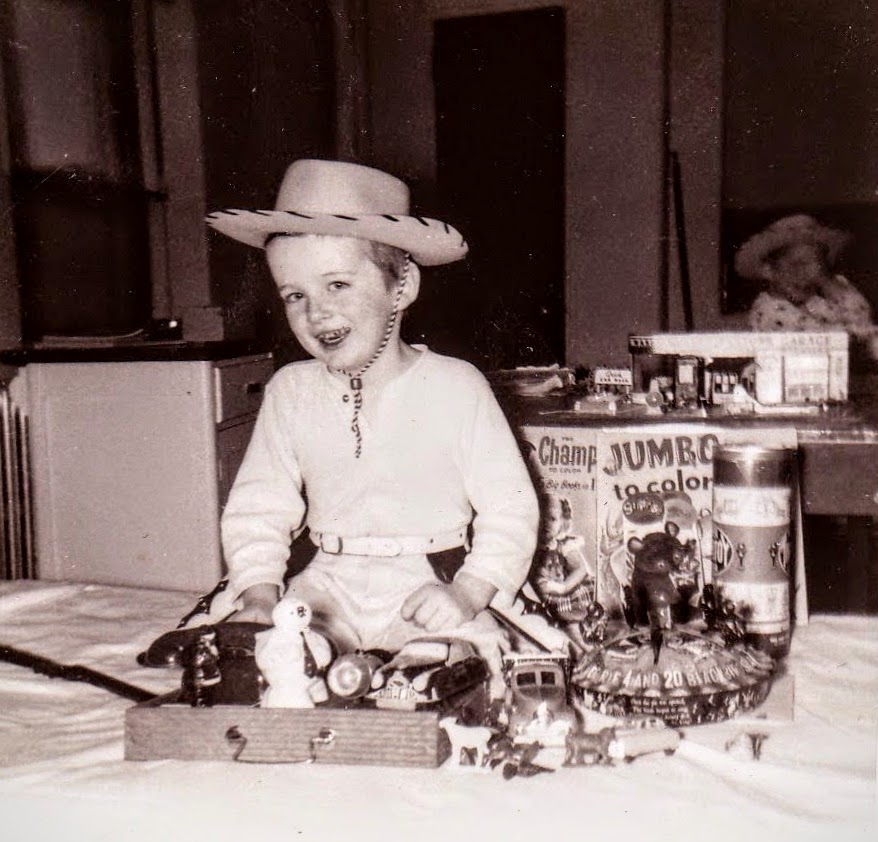
That musical tin pie at my side is one of the favorite toys of my life. I cranked a handle on the side, and a soft rubber strip with raised prongs played the melody of Sing a Song of Sixpence on metal strings within. Several blackbirds popped out of slots on top of the pie when the music ended. Here, my family has visited me in the sanatorium and brought me presents. I was a sugar addict, and we were born with soft teeth: My top row of baby teeth are largely decayed. I was happy, though. I didn’t care. The white border of this photo, which I cropped, reads at the top 1954, and at the bottom Johnny.
When the Diablo Winds come. In October of 1991, I stayed for a while with my longtime friend Hiroshi Omura. He owned a home in the Oakland Hills, situated above Berkeley, California. His home was my on-paper U.S. residence when I was a world traveler—I lived ten years on and off in different locations in Japan. His partner was in Arizona for some reason. Don Pemberton is his name. In late October, one day, we were lounging about the house. On TV, we saw from the San Francisco side of the bay streaming dark smoke in the air over the Berkeley and Oakland Hills. We watched the emergency broadcast more closely: A large canyon fire, wildfire, firestorm now—fire driven by its own wind—was raging below us in the crevasses and twisty places where I often rode my bike for exercise. The reports were calling it that afternoon the Santa Ana winds that had come in from the desert; hot, dry, strong winds that almost never get as far as the San Francisco Bay. It turned out they were something else, the Diablo Winds, blowing in from the Diablo Valley, still hot, dry, strong winds that rarely cross the high hills and enter the wide expanse of the bay, displacing its cool, moderately humid air.
Hiroshi called a friend in Diamond Heights, San Francisco. He had a large, sprawling apartment. We went and stayed there for two nights. It had started to look very urgent, so Hiroshi gathered a few things, and we took off in his Mitsubishi pickup. I thought that if I were leaving my home for perhaps the last time, I would fuss with what to take. He did not care: He grabbed only a few things that he needed, and we took off. I was traveling light, so it did not take long for me to find my possessions and take them to the truck. It seems that I was visiting from Michigan then, perhaps looking for work in California, or just taking it easy: I don’t remember.
Two days later, we went back to see about his house. A young police officer asked for our IDs before he would let us through the hazard ribbon. He was not quite confident about letting Hiroshi in, so I showed him my ID. As I said, his home was my official U.S. residence while I was spending years at a time overseas. Then, the young police officer readily let us through. Hiroshi was pissed at this development—it was his house; it was merely my stated U.S. residence to for tax purposes, passport, and driver license. He turned grumpy. My only thought about him at that moment was: Go fuck yourself.
It seems to me that we walked up into the hills. Vehicles were not allowed. There was a lot of debris, not yet cleared, and vehicles might clog the hilly, winding streets. It seems to me that we left his pickup in the Montclair neighborhood, where the wildfire had not got to. His house was spared, but all around, they were burned to the ground. We did not know the neighbors, but suddenly there they were, their homes exposed to the world, charred black, with only their lonely, useless fireplaces—chimneys and all—standing jagged against the afternoon sky. The next day, we came back with a vehicle and stayed, and soon I moved on, back to Michigan or Japan or wherever I was headed. You will not forget when the Diablo Winds come: There is a strange beauty in it, along with frightening destruction.
Seventeen. Last night, I watched on Netflix the Spanish film Seventeen, or diecisiete. I have never seen a better film about brothers. It stars Biel Montoro and Nacho Sanchez: Some of the smartest acting I have ever seen, and one of the smartest, day-in-the-life stories I have ever seen.
The Deep Community. Here, I will unfold a conspiracy theory. There are those on the right who talk about the Deep State: The entrenched bureaucracy will remain the entrenched bureaucracy, the self-perpetuating, barely competent apparatus of the state will hum on and on, no matter what anyone thinks or tries to do about it. True—that is a truth. At its extreme, it is the downfall of nations. Officials got so set in their ways that they fowled up the water system. The mountains always provided a rush of fresh water in the spring: melted snow and ice flowed through elevated ducts and ground-level channels, which brought clean water to the people in the towns—until they didn’t. Who can plan for a once-in-a-hundred-year drought? The deep state doesn’t always work. We know that.
Here is the lesson I promote: If the intelligence community sees you as a goofball, your days in office are numbered. They will handle the levers of power so skillfully that you will not even know what happened. They will remove you from office. Those who work in the intelligence community have cozied up to the grand vision of who we are and of our place in the world—any diversions from that, be damned. They could have a once-in-a-hundred-year drought, I suppose, but I am guessing not. Final word: Never do anything as loud or as obvious as Bay of Pigs. Trust me: I know this territory. Read my next paragraph; you will see.
On streaming services, I am always drawn in by the taut conspiracy thrillers, the perfectly plotted revenge stories, and the action movies with a story beautifully told, especially the ones where the action-conspiracy-thriller hero runs through upper-level flats in ramshackle neighborhoods where nuclear families are having lunch or dinner or are sitting on a sofa watching TV; the hero might fight with the hung-up washing on the clothesline set up on a flat roof and surprise everyone by running for his or her life and making way to the next building, perhaps by jumping from roof to roof. The writer, and then the director, situate the thriller-action-revenge story with the people that matter; people going about their lives, while incredibly sophisticated plots unfold around them—ones that the viewer sees as making life that much more rewarding, as the characters sit about the dinner table telling it like it is, and loving each other richly, beautifully, profoundly. I know this territory: Trust me—eh!
These people, as portrayed in these films, put their lives on the line in dangerous moves that seem to really, really matter, just to get one cog to advance in the vast machinery of the world order: They will not be taking their orders from an over-opinionated jerk, jackass, ingrate, who does not even know what a grand vision is, something that Christianity made us believe, and we couldn’t get out of our heads even if we wanted to—a better life in the spirit awaits. Some of these folk have their name on a version of the Bible: a mere token that will generate a little income, but because they lack depth of soul, they don’t know the first fucking thing about the grand vision promised in that book. You need depth of soul; you need to believe deeply in getting to a place where things are good, really good, not just populated-with-wealthy-white-folk good—according to your sensibility. You need the vision; you need the grand vision, because the men and women and transgender men and women moving the cogs of power in the vast world order know what the fuck they’re fighting for, and you don’t. They are not merely moving the levers of power; they have whittled the levers of power with their sweat and muscle and blood—and they know what the fuck they are talking about.
The wind picked up in the morning and blew strong all day; it swirled and lifted, and it was strong. The moment was exactly that moment when all the snow has melted off the land, and that a stream in the ravine in the pasture across the road forms and glistens with the sudden snow-melt—it takes a heavy rain or rapid snow-melt for that stream to form at all, and it picks up the colors of the sky and reflects and ripples and flows. It enters a culvert and crosses the road and contributes to a full-time stream, that, three miles on, joins the river, which, fifty miles on, flows into the the big lake. The wind blew in hard gusts, and this is what it did: It filled the air with a light haze, made of dust. The yellowed grasses, some tall, some short, held onto the dust particles left by the melted snow. No green had appeared at that exact moment when the snow had gone off the land, and the wind blew fierce and picked up all those dust particles and suspended them in the air and made a haze that lasted all day—is it not a fact that each snowflake forms on a particle of dust? I read that once, I think. Well, those particles of dust lay just right on a dry, warm, late-winter day and went back into the air, suspended there. They remembered their existence, their transformation, their place on the ground—and they found their glory on a dusty, late-winter afternoon.
 johnbattle1.blog