Carmeleta Battle Hays Schulz
My Memories
By John Charles Battle
Carmeleta was the oldest of us thirteen siblings; I am the youngest. She died on Saturday, April 5, 2025.
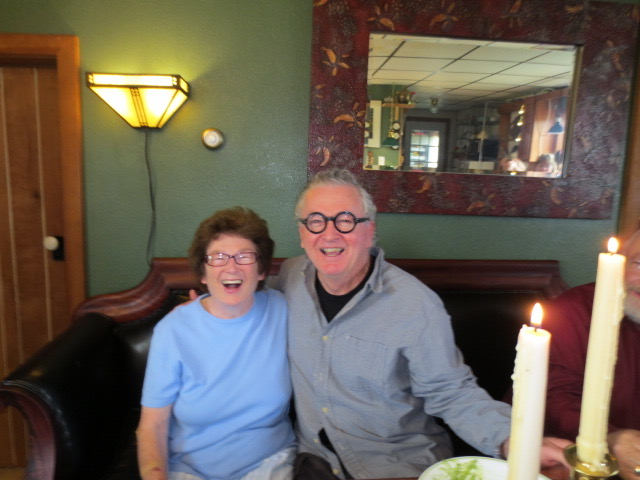
This photo was taken on a summer’s day in 2013, at our family home on 21 Mile Road, Paris, Michigan.
Carmeleta could not think of Fred’s nephew Kenny Hays without crying. He wrote her a letter from Vietnam, expressing his hopes for the future when he would be home in a few weeks. He was killed in combat before he could make it home. And she could not think of the neighbor’s son without crying, one of the Reckney boys: He stopped on the road one day and came up the front bank of the yard and hugged my mother goodbye when she was putting laundry on the line. He went off to the Army and off to the war: And he never came back. Another time, She made me tell a story that I had almost forgot. I had been in a sanatorium for Tuberculosis when I was between four and five years old, for eleven months. She asked me what I remembered, and she wanted to know. I told her I imagined myself in a small peddle car—a rather elaborate, small version of a convertible automobile that, with one or two children on the seat, could be operated by peddles—and I would peddle my way home from the hospital. The distance was one hundred fifty miles, so that was not very likely. She cried. However, I must say that I did not feel abandoned when I was there. I simply interacted with my same-age ward-mates and the care staff. It was my new reality, and I did not suffer there, that is, except when they served soft-boiled eggs on a certain morning of the week—the kind that come in a little egg cup and you whack with a spoon to remove some shell and dig out the snotty coagulations—extraordinarily unpleasant to my five-year-old palate. I could not eat more than two bites, and the nurses got testy—but I simply could not.
Things happen, and life will never be the same. When you have a very large family—we were thirteen siblings, and I have more than fifty nieces and nephews, and the extended family that you can expect from that—the journey is epic, and the road is long, and we know in our hearts that we will not come this way again. Life is lived in its small moments.
I am studying the Franklin stove in the living room on an early autumn Saturday evening, when Mother has started making fires again that last all day and into the evening. I wonder about the little panels in the fire door. They are translucent, something like glass, but not glass; they are mica, and they don’t burn or melt or get too hot, it seems. I like the way that potbelly stove gives off heat, and I like the orange-yellow glow of the mica panels. Mother is in a rocking chair in front of the daybed in the kitchen; she whispers the words to the rosary as she moves the beads through her hand, and gently rocks back and forth. Daddy is at the end of the kitchen table, reading another Zane Grey novel or the Readers’ Digest or one of last month’s New Yorker magazines—friends, neighbors, and relatives knew his vast appetite for reading material and regularly supplied him with their used items, except Reader’s Digest: He subscribed to it.
In the Great Unity of Souls, we will remember this; we will know this; this is who we are. We made life happen, one small moment at a time, and it was beautiful.
Three summers ago, Ken and Carmeleta and I traveled north on Garfield Avenue SW, in Grand Rapids. We were there because my coffee bean supplier occupies a space in an old, closed-up factory along there. Carmeleta pointed to another very large, old, pale-brick, closed-up factory: McInerney Spring & Wire.
“That was one of my first jobs,” she said.
I inquired: “So you worked in the office; you did bookkeeping?”
“No,” she said, “I worked on the factory floor, working with wire.”
President George H. W. Bush was famous for saying: “The biggest part of success is showing up.”
I sort of liked him, though I am a progressive.
Carmeleta showed up; she believed in work, earning money, paying bills. I liked her outlook on life, even though I am more of a dreamer. I love the arts—performing arts, visual arts, along with the behind-the-scenes technical aspects of the arts such as cinematography.
My brother Dave and I are the youngest members of the family. Most summers, after we were about eight and ten, we spent about a week at Carmeleta and Fred’s home on Eastern Avenue, near 28th Street, in Grand Rapids. Those are lively memories for Dave and me. They drove us to Atlantic Mills for shopping, out on Ann Street, I think. It was a big arena, with an arched roof, full of retail goods. When we left town by way of Plainfield Avenue, the original, long, low-slung, bright yellow, lighted arches of the first McDonald’s in the city made an impression on me. I began to like urban life, though I had known little of it before.
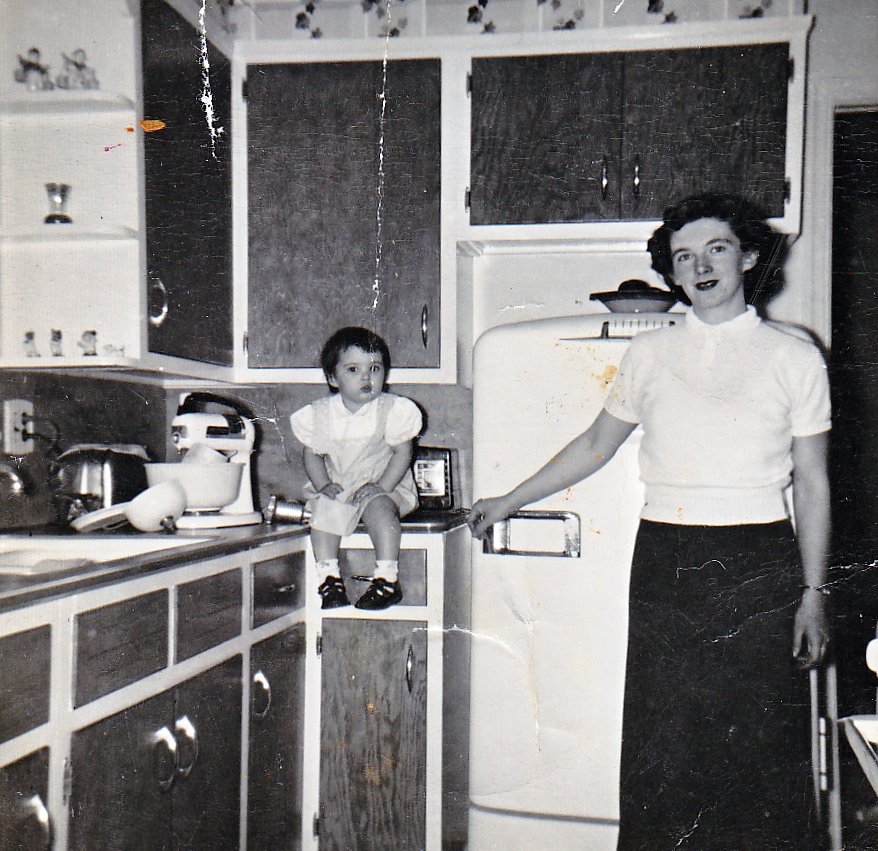
It seems everyone had plywood kitchen cabinets in those days. Carmeleta’s kitchen was no exception. Her daughter Patty is seated on the counter.
Mother was close to nature: We had nature in our heads and mostly love in our hearts, growing up. Dave and I picked Canadian Violets in the woods in back of our house in May so that Mother could decorate the statue of Saint Anne with them, the one on the left side of the sanctuary of Saint Anne Catholic Church—it stood just a mile from us across the section.
We marked the seasons well, wandering through the woods and fields around us: No one cared much then about property lines. We wandered all summer, until we had to go back to school: St. Philip Neri Elementary, Reed City.
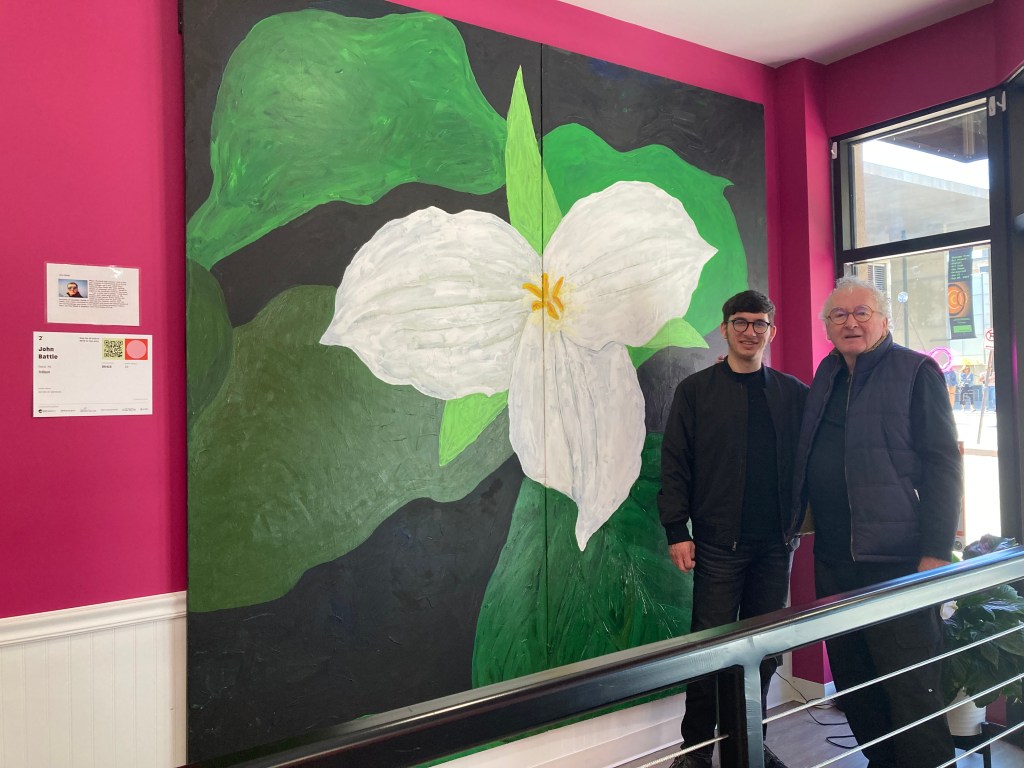
This is what I do now. I paint pictures, usually rather large, and I write fiction stories. I also work for an academic testing company three or four days a week. I am pictured here with my great grandnephew Conner Fuller, a Literature student at Ferris State University, Big Rapids. This is from early fall 2023.
If you knew Carmeleta, she lives now in your heart and in your soul. She is part of the good in you. I will never forget the life-shaping example that she was in my life. I am a lover of good food and culture and the small joys of life, and especially of people. She helped us learn how; she taught us to show up for life and for one another, and—yes—work.
My parents were part of the world of great ideas. You may not know, you may not care—but they were. They had their values: They saw the world and assessed it according to their ideas. I studied philosophy in college because I knew this world. My mother had a way with words—They are still wasting their time arguing over last year’s bird’s nest—that sounded cynical and harsh only at times. She participated in the world of great ideas, and she did not fully appreciate it. My father read all day every day that he was off work, mostly all winter, when he arranged with the union steward to take a layoff: He was sly and calculating, and he imparted wisdom carefully, sneakily, with a rare expression here and there, now and then. They did not listen to Mozart and Bach on the radio. They were not full participants in the arts, but they knew a lot, and they imparted it to us. They were never overbearing. I like my father more as the years wear on.
When I think of my generation especially—and of those who come next—I know this:
Our journey is epic. It matters; we matter. We define ourselves every day by how we act and what we believe.
Our road is long. My family was large; and we saw it all, and felt it all, and came know all the places that life can take us.
We have great hope for eternal life, but we also know this: We shall not pass this way again.
Our journey is epic. Our road is long—and—We shall not pass this way again.
 johnbattle1.blog